For many people in Ireland, the idea of home has long been associated with a house: a front door, private garden, driveway, family space and long-term ownership. This preference reflects how Irish towns, suburbs and communities have developed over generations, and how housing has traditionally been delivered across the country.
Recent Eurostat data helps put this into a wider European context. In 2024, 90% of Ireland’s population lived in a house rather than a flat or apartment, the highest share in the EU, compared with an EU average of 51% living in houses. Census data published by the CSO also shows that 87% of occupied properties in Ireland were houses in 2022, while 13% were flats or apartments.
This article explores Ireland’s strong house culture, how compact-growth policy is broadening the conversation, and why apartments and other forms of compact housing still have an important role to play in addressing the country’s housing needs.
Why Ireland has such a strong house culture
Ireland’s preference for houses is deeply embedded, and part of this can be traced back to the country’s historic relationship with land, ownership and security. As noted by the National Economic and Social Council, Ireland’s housing culture has been shaped by historic land reforms, including the Land Acts, which allowed many tenant farmers to purchase their holdings and helped expand rural homeownership.
This history helped reinforce the idea of the house as a stable and desirable form of home. For many people, a house has long been associated with independence, privacy, family life, outdoor space and long-term security. Houses continue to provide the space and familiarity that many households value, particularly for families and people seeking long-term homes.
Over time, this long-standing pattern has also shaped expectations around what housing should look like. In many parts of the country, apartments are still more commonly associated with city-centre living, student accommodation, rental housing or shorter-term stages of life, rather than as long-term homes for a wider range of households.
The role of apartments in housing delivery
Although compact growth is wider than apartment delivery, apartments still have a major role to play, particularly in central and accessible urban locations. The Government’s 2025 Design Standards for Apartments describe apartment supply as a crucial part of the overall housing mix, especially in places close to existing facilities and services. They also expand the range of housing available for smaller households, renters, first-time buyers and people seeking alternatives to traditional family homes.
However, recent figures show that houses continue to account for the greater share of delivery. According to the CSO’s Q1 2026 completions data, houses within multi-unit developments, referred to as scheme dwellings, accounted for 52% of new completions, compared with 30% for apartments and 18% for single dwellings. In planning, the CSO’s Q1 2026 planning permissions data recorded 3,153 apartments granted permission, compared with 4,939 houses.
Housing completions by dwelling type in Ireland Q1 2026
52%
30%
18%
Scheme dwellings52%
Houses built as part of a multi-unit housing estate or development
containing two or more houses.
The cost of delivering homes in Ireland
If apartments are an important part of addressing housing demand and can deliver more homes on a single site, why do houses continue to account for a greater share of new housing delivery? Is this simply a reflection of Ireland’s house culture, or do other challenges come into play? Well, cost is also an important factor to consider.
The SCSI’s Real Cost of New Apartment Delivery 2025 report estimates that the total development cost of a lower-range two-bedroom urban apartment is between €523,000 and €537,000, while a lower-range suburban apartment reaches approximately €541,000.
For reference, the SCSI’s latest housing-delivery study, published in 2023, placed the average cost of delivering a three-bedroom semi-detached house at €397,000 nationally and €461,000 in the Greater Dublin Area. These figures cover different years and dwelling types and are not a direct comparison, but they help illustrate the scale of the costs involved in apartment delivery.
Apartment projects can also require more capital for longer. In a 2019 analysis, the Central Bank of Ireland explained that houses within a larger development can often be completed and sold in phases, allowing income from earlier sales to support the next stage of construction. Apartments generally cannot be sold until the entire block is complete, meaning more capital remains tied up for longer. This can increase financing risk and helps explain why house-led schemes may be easier to progress commercially in some locations, although viability ultimately depends on land costs, sales values, finance and the individual development.
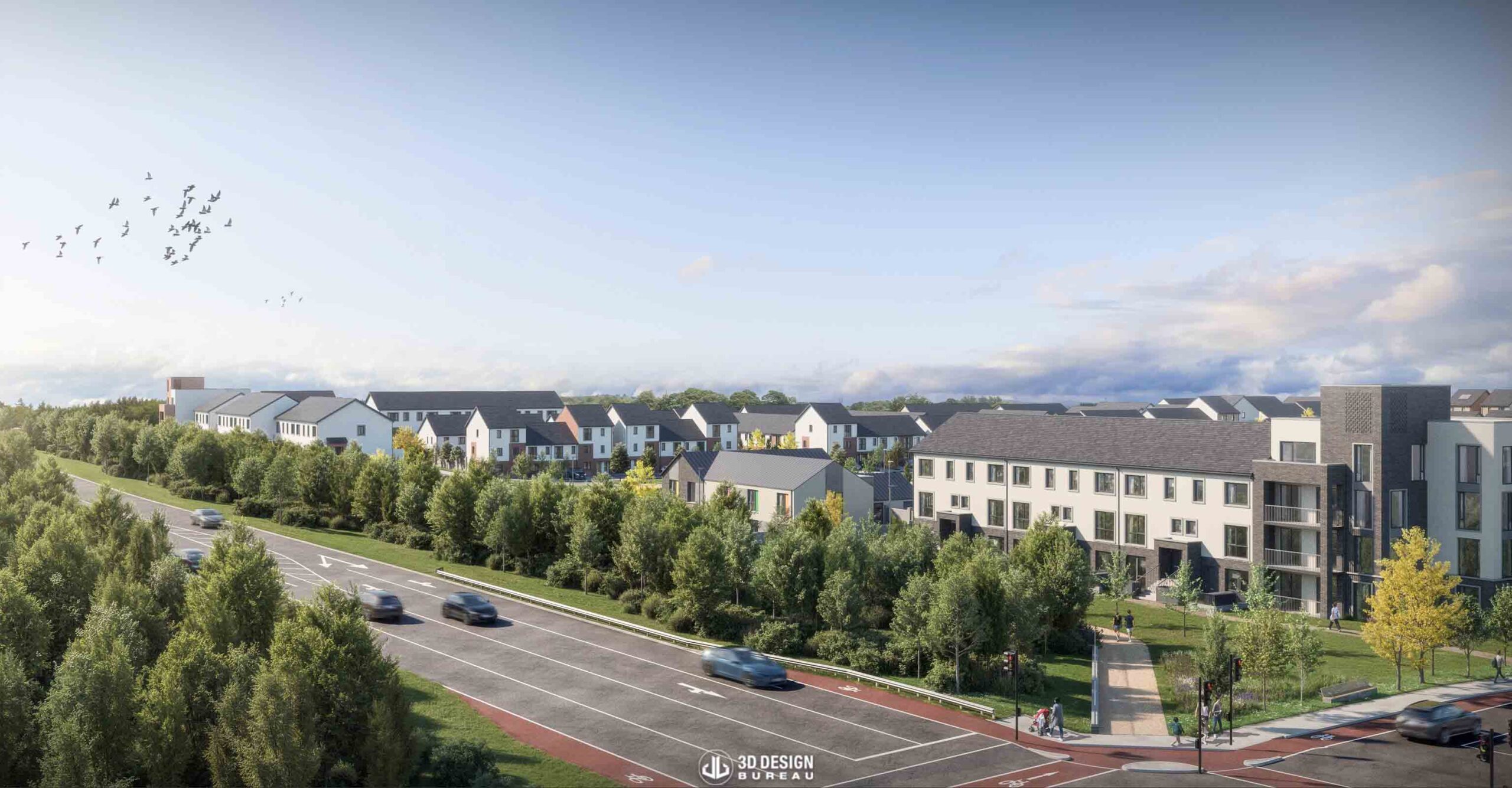
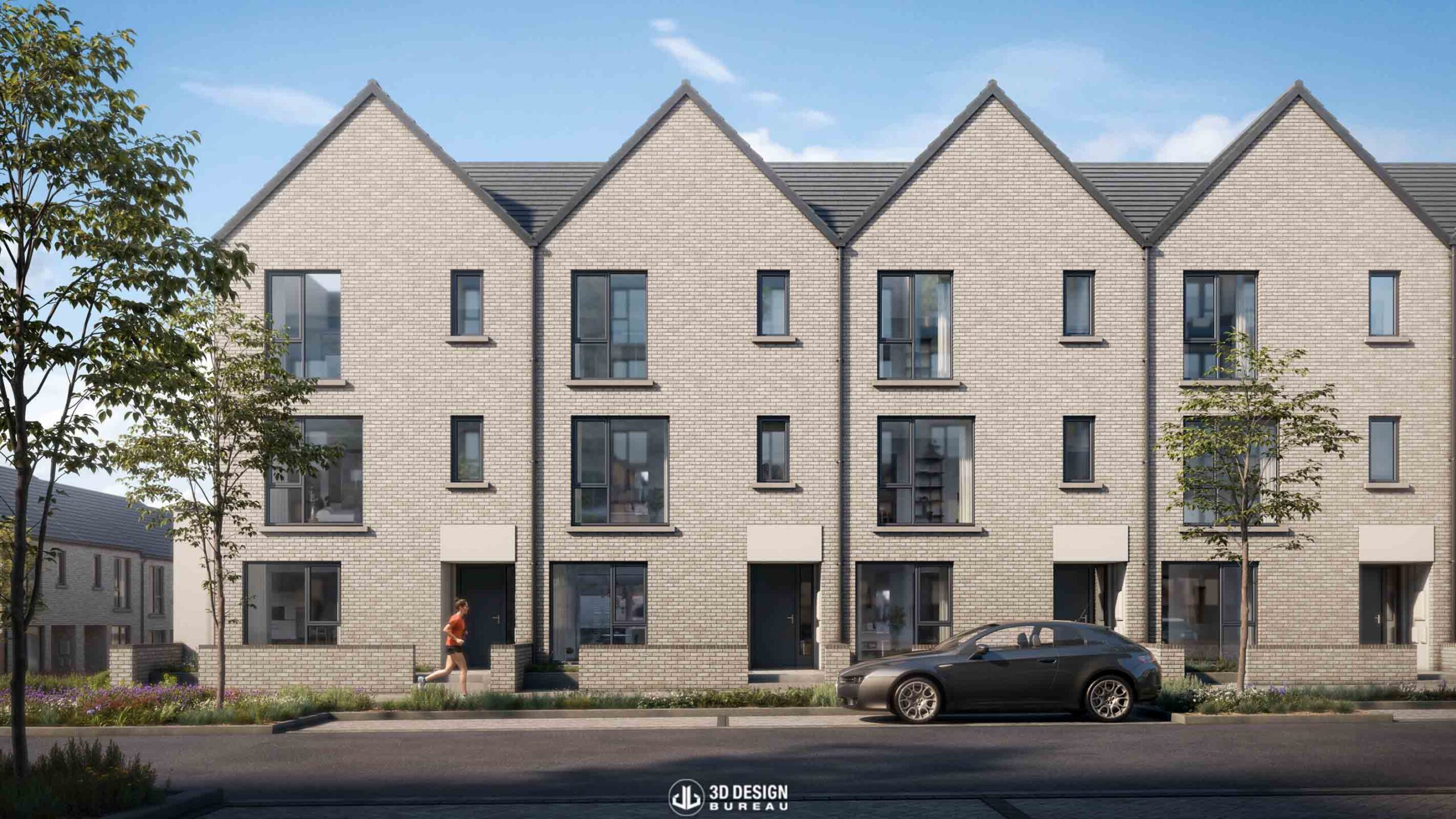
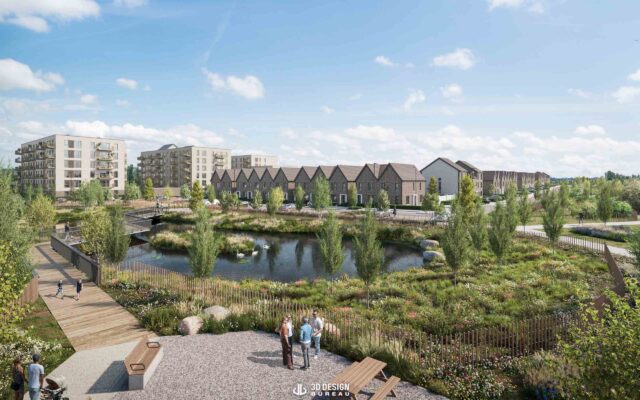
Architectural CGI of houses within a multi-unit residential development
How planning affects housing delivery
Planning is another important factor affecting housing delivery, whether a development comprises houses, apartments or a mix of both. Apartment developments are not necessarily more difficult to secure planning permission for, but they can involve greater complexity. Residential schemes must navigate planning policy, design and environmental requirements, infrastructure constraints and site-specific concerns, while appeals or judicial reviews can add further time, cost and uncertainty. According to An Coimisiún Pleanála’s latest published annual report, the average time taken to decide all planning cases in 2024 was 41.7 weeks.
Reforms being introduced under the Planning and Development Act 2024 aim to improve the clarity and consistency of the system. However, clear technical information and high-quality planning visuals remain essential for effectively communicating how proposed homes will integrate with their surroundings. Detailed visualisations and technical 3D solutions can help demonstrate how a scheme addresses key considerations such as height, density, privacy, public realm and neighbourhood character. We explored this further in our article on why architectural visualisation matters in apartment planning applications.
Ultimately, Ireland’s housing challenge cannot be addressed through one single housing type or solution. Progress will depend on delivering a wider mix of homes while addressing viability, infrastructure and the needs of growing communities. We explored another part of this wider picture in our article on how infrastructure impacts housing delivery in Ireland. Bringing these different elements together will be essential to delivering the homes Ireland needs.
Author:
Lucas Imbimbo Digital Marketing Specialist at 3D Design Bureau lucas@3ddesignbureau.com
Permission granted for 159-home Bray scheme, completing Phase 1 of Sea Gardens
Following a third-party appeal, An Coimisiún Pleanála has upheld planning permission for a new residential development on former Bray Golf Club lands, off Dublin Road and Ravenswell Road, Bray, Co. Dublin. The approved scheme will deliver 159 homes as part of the wider Sea Gardens development, comprising 150 apartments and 9 townhouses.
Seven Mills: Work continues on the new 660-unit phase, Wicker Walk
Work continues on Wicker Walk, a new phase of the wider Seven Mills, Dublin’s newest town. This phase provides for a major mixed-use scheme comprising 660 homes, including houses, duplexes and apartments, together with a crèche, community floorspace and extensive public open space.
Permission upheld for 57-home development at Scholarstown House
Following an appeal, An Coimisiún Pleanála has upheld planning permission for a new residential development at Scholarstown House, Scholarstown Road, Dublin 16. The approved scheme will deliver 57 homes in total, comprising apartments and two houses.
We use cookies to ensure that we give you the best experience on our website. If you continue to use this site we will assume that you are happy with it.