The planning process for property developments in Ireland can be complex and time-consuming, involving multiple stakeholders and regulatory requirements. Engaging early with local authorities, through a pre-planning meeting, and potentially the local community through a public consultation, can be crucial to navigating this process successfully.
A key consideration for design and a successful planning application is the selection and engagement with a project design team. A strong team of consultants, generally led by the project architect or planning consultant, will help guide the development through the pre-planning process (if applicable) and onto the full application submission. The team is generally made up of, but not limited to, the following members:
Project manager – Generally appointed on large-scale projects such as an LRD (Large-scale Residential Development).
Project architect – key to good design within the framework of local policies and potential constraints.
Planning consultant – Vital to ensure a robust application, particularly on sensitive sites.
Engineers – Road, traffic, structural, M&E etc. All fundamental to ensure a commercially viable scheme design.
Landscape architect – Delivering essential hard and soft landscaping design that ties in with sustainability, useability, and local environmental objectives.
Environmental impact assessment (EIA) consultant – Where a scheme is deemed to have a ‘significant’ impact on the surrounding environment, then an Environmental Impact Assessment Report (EIAR) will be required. For residential development, the prescribed threshold includes schemes of more than 500 dwelling units. Developments below the relevant thresholds may still require EIA where their characteristics, location or potential environmental effects indicate that significant impacts are likely.
Daylight and sunlight consultant – One of the most ‘looked at’ and important reports of a planning application for small or large-scale developments. Analysis of the scheme’s performance and potential impact on surrounding properties is fundamental.
Wind analysis consultant – Important from environmental grounds. It will also measure how comfortable open amenity spaces and thoroughfares will be for a scheme.
CGI consultants – Verified View Montages (VVMs) are a critical component of any planning application. Pictures paint a thousand words for planning authorities.
Request for a pre-application meeting
For many projects, submitting a request for a pre-app meeting is advisable and, for certain types of development, is a statutory requirement. This meeting is known as a Section 247 (S247) meeting. It is formally requested through a completed form by the applicant along with the submission of the design and consultant information to be discussed in the meeting – such as site location maps, scheme design and its rationale, sketches, 3D renderings, verified view montages, environmental reports (full or partial) etc.
The S247 meeting allows the promoter of the scheme, generally through the project architect or planning consultant, to table the proposed design and explain its approach and rationale for it. It also affords constructive dialogue with the planning authority, helping the project team understand its initial views on the scheme, whether it is ready to progress to a full application or whether further attention may be required by the design team.
Note: This S247 meeting should not be mistaken for the formal LRD meeting under Section 32B, which is a separate pre-application stage for large-scale residential developments. Following the S247 consultation, the prospective applicant can request an LRD meeting. The planning authority must hold this meeting within four weeks of receiving a valid request and, within four weeks of the meeting, issue an opinion on whether the submitted documents provide a reasonable basis on which to make a planning application and identify any matters that may need to be addressed.
Where significant design changes or additional considerations arise following the initial S247 consultation, further pre-application engagement with the planning authority may also be appropriate.
Important: Ireland’s pre-application process is changing under the Planning and Development Act 2024. Until the relevant parts of the new Act come into effect, the current Section 247 process continues to apply. Once commenced, it will be replaced by the new pre-application consultation framework, including updated requirements for large-scale residential development.
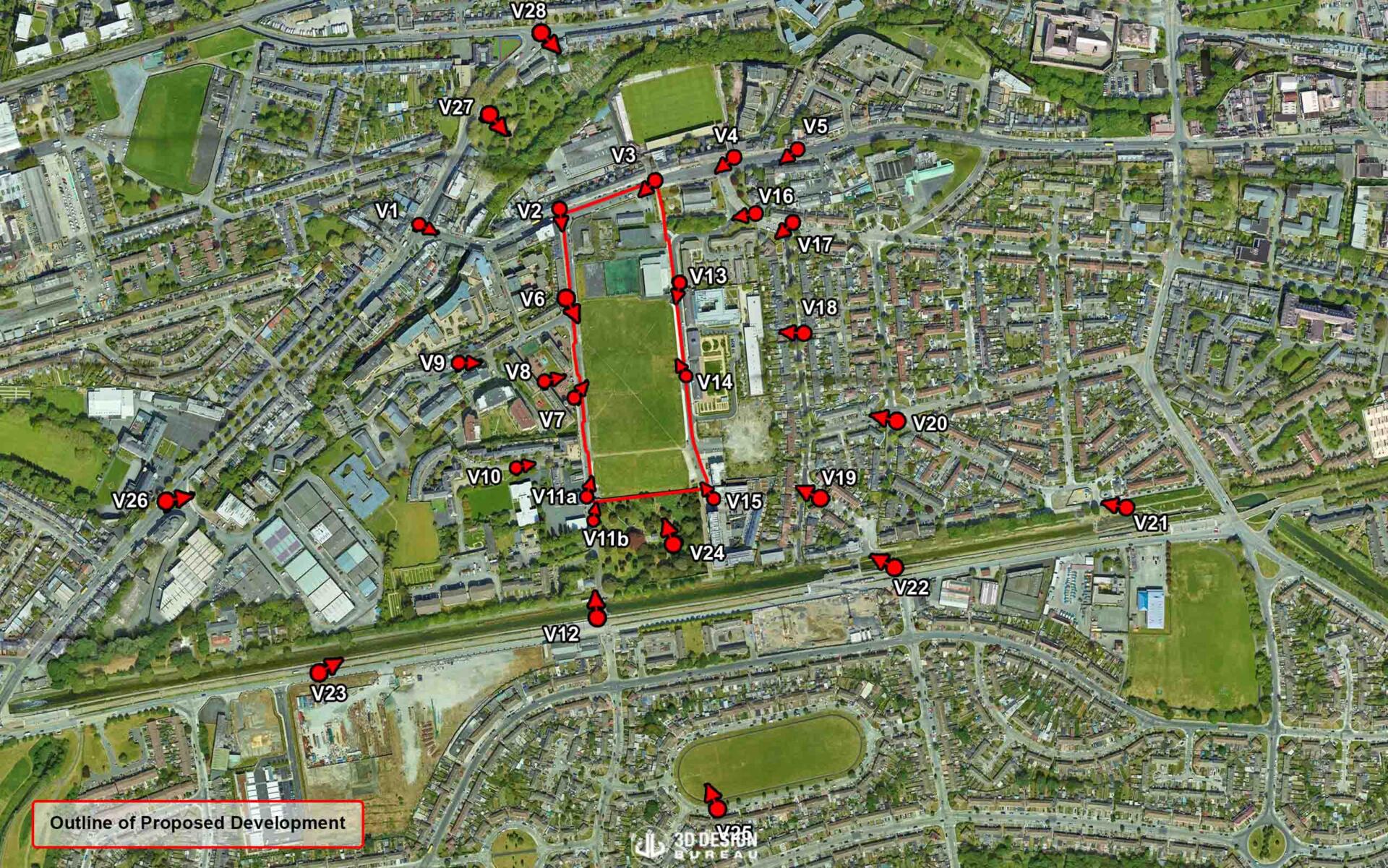
💡 Pro tip: For planning authorities, verified view montages are pivotal in understanding the visual impact of a scheme. In fact, for large-scale applications, they are now considered a prerequisite. These technical photomontages provide an accurate depiction of the visual impact a proposed development will have on its surroundings and adjacent structures and can greatly influence a local authority’s opinion on a scheme. Based on our experience, the inclusion of verified view montages not only assists in securing planning permission but also can significantly save costs and valuable time in a project.
For sensitive large-scale developments, and particularly for public infrastructure projects, engagement with the public may take place before the full planning application is submitted. This pre-application public consultation can involve presentations explaining the proposed scheme, its design and how it may integrate with and bring value to the surrounding area and community.
Early public consultation can be particularly valuable on certain projects, allowing the project team to engage with local communities and stakeholders, gather feedback and identify concerns at an early stage. This feedback can help inform the design and provide a clearer understanding of issues that may need to be addressed before the planning application is finalised.
Pre-Planning Timelines (under the current Section 247/LRD framework):
- S247 pre-application consultation: Within 4 weeks for certain larger developments; otherwise, undetermined.
- Section 32B LRD meeting (where applicable): Within 4 weeks of a valid request.
- Local authority’s written opinion on the Section 32B LRD meeting – Up to 4 weeks after the meeting.
- Pre-application public consultation: Undetermined.
- Timescale for full planning submission following a pre-application meeting: Undetermined.
- Time frame for the applicant to lodge planning following a pre-application meeting: Undetermined.
Note: Some timeframes or requirements may vary according to different local authorities and specific circumstances of the proposed development.
Read the full series!
- First stage: The importance of the feasibility studies
- Second stage: Design, pre-planning, and public consultation
- Third stage: Full planning application submission
- Fourth stage: The planning decision

Author:
Lucas Imbimbo
Digital Marketing Specialist
at 3D Design Bureau
lucas@3ddesignbureau.com

